Quick brief
- Launch multiplayer is capped at eight players and uses peer-to-peer networking.
- AI can fill open slots, so a small group can still practise team play.
- Team games reward complementary jobs: reconnaissance, main-line pressure and economy disruption.
- Pre-launch build orders are unreliable; scouting and adaptation are the real opening.
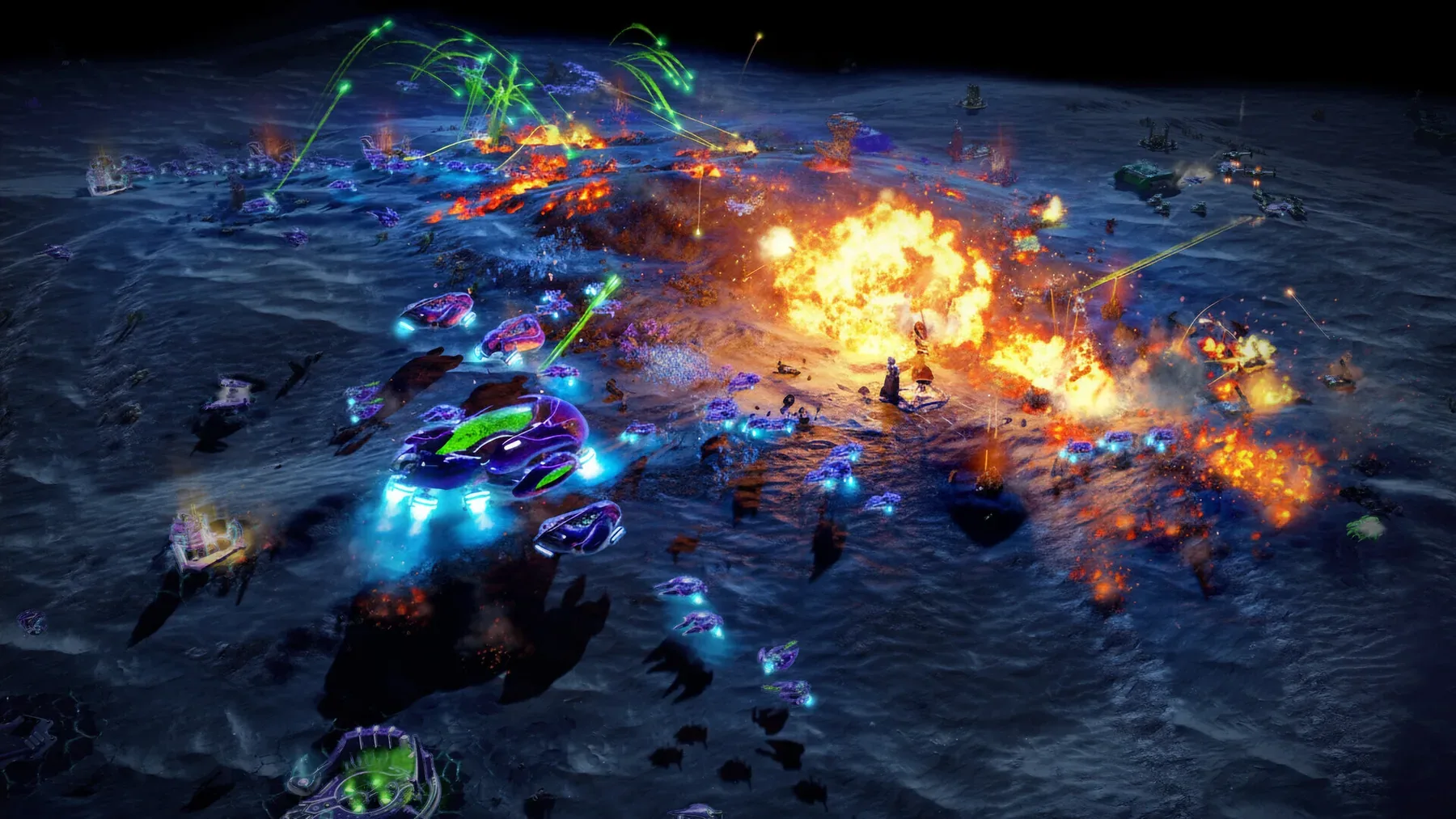
Ashes II multiplayer is not a smaller version of the campaign with human opponents dropped in. The scale is the point: maps can support enormous armies, and every player is making decisions about regions and production while a battle unfolds elsewhere.
You do not need a 300-actions-per-minute opening to participate. You do need a plan for the map, a way to reinforce it and enough discipline to stop attacking when the fight stops making sense.
The confirmed launch structure
- Up to eight players in a match at launch.
- Peer-to-peer networking, with the player limit tied to connection quality.
- PvP and online co-op, including team matches.
- AI backfill for open player slots.
- Offline campaign and skirmish available outside multiplayer.
- Procedurally generated maps alongside prebuilt maps for skirmish and multiplayer.
- Public and private lobbies were available in the demo; launch UI and features can differ.
Peer-to-peer does not make the game single-player-only or casual. It does mean that a stable, local group is likely to have the best experience in the first weeks. If you plan to play with friends, arrange the lobby in advance and confirm everyone’s connection before the match starts.
The team is a system, not a shared army
In a team game, you each control your own economy, production and armies. The team wins when those systems cooperate.
A useful way to think about roles is by time and space:
The reconnaissance player
Finds the enemy’s production, identifies the first heavy push and watches map links. Information is not a side job; it is what lets the rest of the team spend resources on the right units.
The main-line player
Builds the force that can hold the most contested route. This player needs the most support and should communicate when the line is about to break.
The pressure player
Attacks a secondary axis, raids production or forces the opponent to split. The goal is not necessarily to win the duel; it is to make the enemy’s main plan late.
The economic / siege player
Invests in long-range fire, production capacity or a late-game platform. This is not a passive role. A siege player who cannot protect their investment has simply built a target.
These roles are not locked. They are jobs that can rotate as the match changes. The important thing is that the team knows who is doing what.
The first ten minutes
Pre-release balance is not reliable enough for a universal opening. What is reliable is the order of questions:
- Where is the enemy? Send fast units along the likely approaches. Do not send a whole army.
- What can I take safely? Expand in connected directions, not toward an enemy you have not found.
- What production do I need for the first fight? Build toward a coherent army, not a museum of every unit.
- Where is my teammate’s weak side? A flank that neither player is watching is a loss waiting to happen.
- What is the enemy’s first big investment? Air, armour, a dreadnought, a forward factory? Start the answer before it arrives.
This is deliberately broad. A specific build order copied from a pre-release stream may be invalid at launch, and it will not adapt to a procedural map.
Communication that actually helps
“Help” is not a plan. Useful calls are specific:
- “Three heavy units moving toward the north link.”
- “I am cutting their production in the east; hold the middle for two minutes.”
- “I lost anti-air. Do not rely on me to cover the next air push.”
- “I can take the Turinium generator, but I need a screen on the west approach.”
- “I am upgrading the HQ. I cannot attack for the next cycle.”
The shorter and more concrete the message, the more likely it is to change a teammate’s decision.
Scouting is a shared map
In a large game, no single player can see everything. Scattered recon is valuable, but shared recon is more valuable. Put eyes on:
- the routes between your expansion and the enemy’s;
- production clusters and high-value regions;
- the link that powers a forward base;
- the approaches to a Turinium generator;
- the side of the map no one has mentioned.
Do not scout once and call it done. Armies move. A quiet flank is not a safe flank.
Fighting together without stacking into one blob
A common team mistake is to merge every army into one giant pile and walk it forward. It feels powerful, but it gives the enemy one target and leaves the rest of the map unplayed.
A better pattern is converging pressure:
- two armies threaten different approaches but can support each other;
- one player fixes the enemy’s main force;
- another attacks the production or the link that sustains it;
- the first player disengages before the enemy can turn the full army around.
The coordination is in the timing, not in physically overlapping every unit. The army system already helps with internal cohesion; the team’s job is to coordinate at the map level.
Countering the obvious plans
Against a heavy armour push
You need anti-armour damage and a way to prevent it from reaching your damage dealers. Long-range units help, but only if they have a screen. Static defences can delay the push, not win the game alone.
Against air
Dedicated anti-air and fighters are the answer. A single anti-air unit will not cover a whole army. Build the coverage into the formation and make sure the air player cannot find a free attack lane.
Against a swarm
Area damage, chokepoints and protected ranged units reduce the value of cheap bodies. Do not chase individual swarm units into open ground; make the swarm come to you.
Against a Turinium lead
You have two options: contest the generators or attack the economy that sustains the lead. Doing neither lets the opponent win on a timer. Decide quickly.
Against a forward-production gambit
Attack the route and the factory, not the army in front of it. Force the opponent to defend the infrastructure that makes the forward pressure possible.
These are strategic heuristics, not guaranteed counters. The launch balance may change which tools are strongest. The principle is to identify what the enemy needs and attack that dependency.
Co-op against AI: the best training mode
The AI uses the same systems and can fill a team. That makes co-op a low-pressure place to practise:
- one player calls the map and the other practises following the call;
- one player focuses on scouting while the other builds the first main army;
- swap roles in the next match so both players learn the whole game.
Higher AI difficulties may gain economic advantages. The pre-release material distinguishes between opponents that are smarter and opponents that receive unfair advantages, so choose the difficulty deliberately rather than treating “harder” as “more realistic”.
Launch-week etiquette
- Do not rage-quit a team match without saying why. Your army is part of someone else’s plan.
- Ask before assuming a beginner wants advice. The match is a shared activity, not a coaching session.
- Expect the first patch. Launch balance is rarely final, and a public match is not a laboratory with controlled conditions.
- Use private lobbies for experiments. You can test a strange composition without making a stranger’s game miserable.
- Protect the new player. The game is large and the interface is dense. A short explanation of army reinforcement is more valuable than a lecture on optimal play.
What is not confirmed
The exact launch UI for ranked play, the final lobby options and the full matchmaking feature set were not fixed in the public material we reviewed. The pre-release demo mentioned ranked and quickmatch as intended for the full game, but we will verify those features in the release build rather than presenting them as guaranteed.
We also do not have final balance data, so any guide that tells you a single unit composition is “the meta” before release is selling confidence it cannot have.
The bottom line
Play the map, communicate the dependency and protect your teammate’s weak side. The best multiplayer army is not the one with the biggest unit; it is the one that arrives with a job, at the right place, while the enemy is looking somewhere else.
Evidence log
Sources & method
This guide uses official Stardock and Oxide Games material wherever possible. Strategy advice is our own interpretation of those systems, not a claim about a hidden optimal build. Values and balance can change between the pre-release build and launch. Last verified November 1, 2026.
Continue the briefing