Quick brief
- The UEF campaign is the tutorial and the narrative entry point; no prior game is required.
- Skirmish, Instant Action, PvP and online co-op all use the core army and region systems.
- Matches can end through the Turinium victory condition or by destroying the enemy headquarters.
- Procedural maps replace memorised layouts with live scouting and adaptation.
Ashes of the Singularity II is built around the same army and region systems in every mode, but the context changes what those systems are for.
The campaign is a guided story. Instant Action is a controlled experiment. Multiplayer is a contest with another person who will exploit the same rules. Turinium turns a conquest game into a race.
Campaign: humanity’s side of the war
The initial campaign follows the United Earth Forces. You play as a Commanding Officer fighting against Post-Human expansion and Substrate schemes on a journey that takes the conflict back to Earth and across the solar system.
Stardock has said two things that matter to a new player:
- You do not need to play the first Ashes game. The sequel introduces the universe and its factions through the campaign.
- The tutorial is woven into the campaign. New systems are introduced as the story progresses rather than being dumped into a separate practice mode.
That makes the campaign the most sensible first stop. It gives you a sequence of problems with narrative framing, and it lets the game teach armies, regions and production before you face a human who has already mastered them.
The campaign is not a separate ruleset. The same army management and regional economy apply. Treat each mission as a chance to practise a specific system, not just a cutscene between battles.
Skirmish and Instant Action
Instant Action and skirmish games pit you against AI opponents on a chosen or generated battlefield. The developers have discussed multiple AI difficulty levels, from a gentle trainee experience to opponents that pressure experienced players. The February 2026 demo offered seven difficulties and supported solo skirmish, team games and AI backfill.
These modes are the laboratory. You can test a composition, learn a map’s chokepoints, or practise a retreat without worrying about a human opponent’s reputation for ruthlessness.
A good use of skirmish is to pick one variable and change it. For example: “This game I will scout before every engagement” or “This game I will keep production within one region of the front.” Focusing on one decision is more useful than playing the same vague game ten times.
Multiplayer: PvP and co-op
Online multiplayer supports both competitive and cooperative play. At launch, the player limit is eight, and AI can fill open slots. The game supports peer-to-peer networking for online matches.
The limited player count is a deliberate quality decision, tied to the peer-to-peer model. It does not mean the battles are small. Each player can command hundreds of units across a large map, so an eight-player game can contain thousands of units.
Co-op can be played against AI, and the game supports offline campaign and skirmish play as well. If you want to learn with a friend without the pressure of a ranked queue, a private match against AI is a strong start.
Does the game have ranked play at launch?
The pre-release developer material states that ranked play and quickmatch were planned for the full game after being absent from the demo. That is not the same as a launch-day guarantee. Treat the exact ranked feature set as something to verify in the release build and patch notes.
Victory condition one: destroy the headquarters
The most direct way to end a match is to break the enemy’s command structure. In the current conflict, the headquarters is the anchor of a faction’s region network and the target that makes a direct assault worthwhile.
Destruction is not just a final health bar. To reach a headquarters, an attacker usually has to solve the defensive layers: the field army, the regional network, the HQ upgrades and the final-tier turret that each faction receives.
For the defender, the headquarters is a deterrent, not an excuse to ignore the map. An opponent who cannot break the front may try to bypass it, cut power links or win through Turinium instead.
Victory condition two: Turinium
Turinium is the returning objective-based victory condition. Teams compete to hold Turinium generators and accumulate points. The match can be tuned with custom victory settings so players can choose a shorter or longer game.
The design is important because it prevents every match from becoming a hunt for the last hidden building. A player who has lost the map but holed up in a corner cannot necessarily force an hour of clean-up. The opponent can win the clock.
How to think about Turinium
- Generators are commitments. Holding one splits your army’s attention and creates a place the enemy must attack.
- The clock changes risk. If you are behind on points, a cautious trade may be a losing trade even if you “win” the battle.
- Map control and points reinforce each other. The routes that let you reinforce a generator are the same routes that let you attack the opponent’s.
- Do not ignore the alternative win condition. If you can win on points, a bloody march toward the enemy HQ may be unnecessary. If you cannot, denying generators may be the only way to stay alive.
Exact point values and generator counts are not published in the sources used here. Check the in-game setup screen on launch day.
Maps: prebuilt and procedural
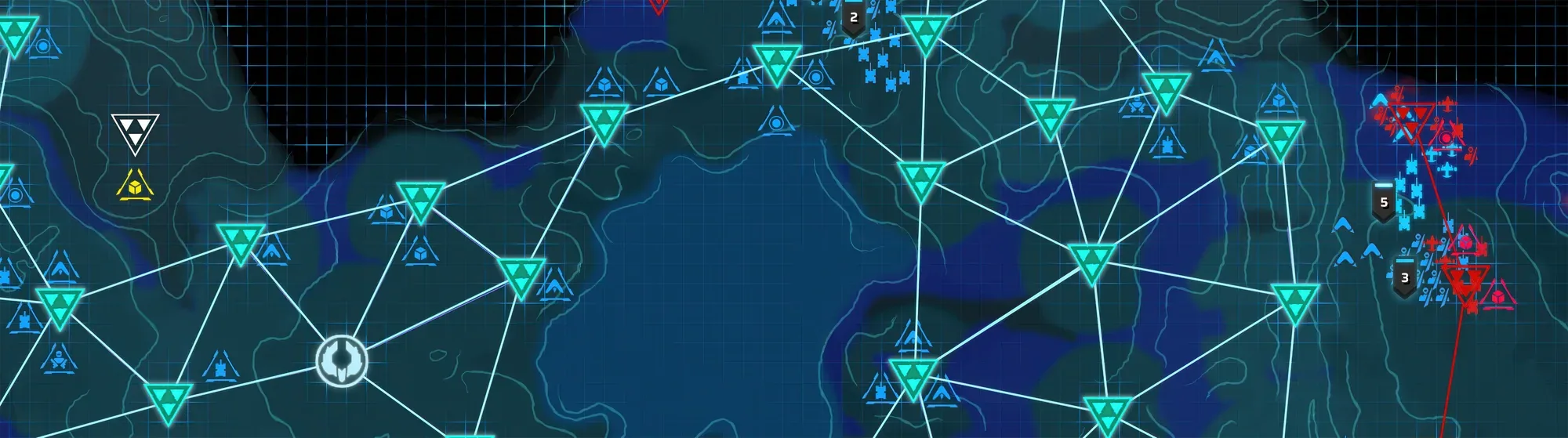
The game includes prebuilt maps and supports procedural map generation for offline skirmish and online multiplayer. The prebuilt maps provide a known competitive layout. Procedural maps create new terrain, which changes scouting, expansion and reinforcement.
This is a meaningful difference from a game where players memorise a handful of build orders. A procedural map may give you a different number of approaches, a different resource distribution and a different set of chokepoints. The correct opening is partly a reaction to the map.
Stardock has also said that a map editor is not planned for launch, though a user-friendly editor is a post-release hope. Do not plan your first month around custom maps.
Persistent battlefields
The environment changes during a match. Structures crumble, terrain is scarred and areas can turn to or from Turinium. The developers describe a “destructive world” rather than a living world: the map records the war.
In practice, that reinforces the value of scouting. The battlefield you see at minute five may not be the same terrain you can use at minute twenty. A route that was open may become a wreck-strewn choke. A forest that provided cover may be gone.
Which mode should you play first?
If you are new to the series
Start with the campaign on a comfortable difficulty. Let it teach the interface and the army system. Then play a small Instant Action match against a low-difficulty AI without the story pressure.
If you have played the original
Try a skirmish against a moderate AI to feel the new army control and region economy. Then pick a faction and test its distinctive mechanic before joining multiplayer.
If you are playing with friends
Use a private lobby against AI. Set the team composition and difficulty explicitly. Everyone should be able to see the same strategic picture; a co-op game is more fun when one player is not secretly carrying the entire economy.
If you want to compete
Learn one map type, one faction and one opening before you try to master everything. The player who understands when to retreat will usually beat the player who knows a flashier unit combination.
Launch week checklist
- Check whether the first patch changes any unit stats or victory settings.
- Confirm the ranked/quickmatch feature set in the release build.
- Play one offline match with each faction before committing to a multiplayer main.
- Try a procedural map and a prebuilt map so you notice the difference in scouting.
- Watch the victory setup before the match starts, not after you are losing on points.
What we still need to verify
The exact number and scoring rules for Turinium generators, the campaign mission count, the final AI difficulty list and the launch-day multiplayer feature set are not fully documented publicly. We will update this page with observed results after release, and we will date every change.
The bottom line
The mode is the context, not the rules. Whether you are defending a story objective or racing for Turinium, the same fundamentals decide the game: connected regions, protected production, a coherent army and a clear reason to fight.
Play the campaign to learn. Use skirmish to test. Take the lessons into multiplayer, where the map will not forgive a plan that only works in a single-player bubble.
Evidence log
Sources & method
This guide uses official Stardock and Oxide Games material wherever possible. Strategy advice is our own interpretation of those systems, not a claim about a hidden optimal build. Values and balance can change between the pre-release build and launch. Last verified November 1, 2026.
Continue the briefing